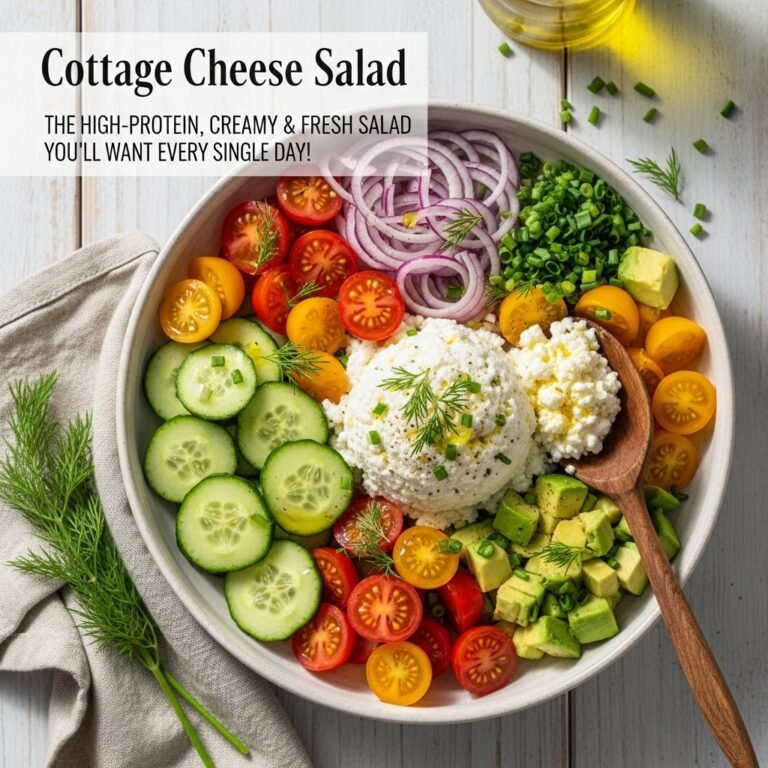
Ingredients
For the Salad:
- 2 cups large-curd cottage cheese (full-fat or 2% preferred)
- 1 large English cucumber, diced into ½-inch pieces (about 1½ cups)
- 1 cup cherry tomatoes, halved
- 1 medium red bell pepper, diced
- 3 tablespoons red onion, very finely diced
- 3 tablespoons fresh dill, roughly chopped (or more to taste)
- 2 tablespoons fresh chives, thinly sliced
- 2 tablespoons fresh flat-leaf parsley, roughly chopped (optional)
For the Seasoning:
- 1½ tablespoons fresh lemon juice (about ½ large lemon)
- ¼ teaspoon garlic powder (or 1 small minced garlic clove)
- ½ teaspoon salt, or to taste
- ¼ teaspoon freshly cracked black pepper
- ¼ teaspoon everything bagel seasoning (optional, for topping)
- Drizzle of extra virgin olive oil (optional, for finishing)
Instructions
🥗 Cottage Cheese Salad Recipe: The High-Protein, Creamy & Fresh Salad You’ll Want Every Single Day!
Introduction
If you’ve been sleeping on cottage cheese as a salad ingredient, this recipe is about to completely change the way you think about it. This Cottage Cheese Salad is creamy, fresh, satisfying, and genuinely one of the most nourishing things you can put together in your kitchen in under 10 minutes. It combines the mild, creamy richness of cottage cheese with crisp fresh vegetables, bright herbs, and a simple seasoning that brings everything together into something that feels both comforting and incredibly clean at the same time.
This cottage cheese salad recipe has been having a serious moment in American home cooking and for very good reason. With the massive surge of interest in high-protein eating, cottage cheese has roared back into the spotlight as one of the most nutritious, versatile, and affordable protein sources available anywhere. Social media has been absolutely buzzing with cottage cheese recipes, and this fresh vegetable cottage cheese salad sits right at the top of the most loved and most saved versions — because it’s not just healthy, it genuinely tastes amazing.
It works for absolutely every occasion you can think of — a quick high-protein breakfast, a light and filling weekday lunch, an easy side dish for dinner, a post-workout meal, a meal prep staple for the week, or a simple appetizer served with crackers or bread. Once you make it the first time and realize just how satisfying and delicious it is, you’ll find yourself making it on a weekly — possibly daily — basis. Let’s get into it!
History & Background
To truly appreciate this cottage cheese salad, it helps to understand the surprisingly rich and fascinating history of cottage cheese itself — one of the oldest, most humble, and most enduring dairy foods in human culinary history.
Cottage cheese is believed to be one of the earliest cheeses ever made by humans. The basic process — allowing fresh milk to curdle and then draining the whey from the curds — is so simple and so ancient that it almost certainly predates recorded history. Archaeological evidence suggests that early cheese-making from curdled milk was practiced in the Middle East and Eastern Europe as far back as 8,000 years ago, and the mild, fresh curd cheese that resulted from this basic process is the direct ancestor of modern cottage cheese.
In early America, cottage cheese earned its now-iconic name from the simple domestic practice of making it at home in small cottages and farmhouses, using the leftover milk from butter-making. Rather than letting this “skimmed” milk go to waste, frugal American farm families would allow it to sour naturally, drain the curds, and season the fresh cheese with salt and sometimes cream. This practical, waste-nothing approach to food production was deeply aligned with American pioneer values, and cottage cheese became a beloved everyday staple in rural households across the country throughout the 18th and 19th centuries.
By the early 20th century, cottage cheese had become one of the most widely consumed dairy products in the United States. It was enthusiastically promoted as a health food by early nutritionists who recognized its exceptional protein content and relatively low fat and calorie profile — making it popular in the diet culture of the 1950s and 1960s, when it frequently appeared alongside a slice of pineapple or a scoop of fruit on the plates of health-conscious American women following the diet advice of the era.
The pairing of cottage cheese with fresh vegetables — cucumbers, tomatoes, radishes, herbs — has roots in Eastern European cuisine, particularly in Russian, Polish, and Ukrainian home cooking, where a fresh “tvorog” (farmer’s cheese or cottage cheese) mixed with vegetables and herbs is a beloved traditional dish eaten for breakfast, lunch, and as a side dish throughout the day. As Eastern European immigrant communities settled across the United States through the late 19th and early 20th centuries, these cottage cheese and vegetable combinations became part of the broader American food landscape.
Today, the cottage cheese salad with fresh vegetables represents a beautiful convergence of American food history, Eastern European culinary tradition, and modern high-protein eating culture — an ancient food perfectly suited to contemporary nutritional values and the fast-paced demands of modern home cooking.
Why You’ll Love This Recipe
This cottage cheese salad genuinely earns a permanent place in your recipe rotation from the very first bite. It manages to be simultaneously filling and light, incredibly easy and genuinely nutritious, simple and surprisingly satisfying — a combination that’s harder to find than it sounds.
Here is every reason why this high-protein cottage cheese salad is going to become a staple in your kitchen:
- Done in under 10 minutes — truly one of the fastest nutritious meals you can make
- Exceptionally high in protein — cottage cheese packs approximately 25 grams of protein per cup, making this one of the most protein-dense salads anywhere
- Naturally gluten-free — works for everyone at the table
- Low in calories but extremely filling — the protein and fiber combination creates genuine satiety
- Budget-friendly — cottage cheese is one of the most affordable high-protein foods available
- Perfect for meal prep — holds beautifully in the refrigerator for several days
- Endlessly customizable — swap vegetables, add herbs, change the seasoning to create infinite variations
- Works for any meal of the day — breakfast, lunch, dinner, snack — it genuinely fits every occasion
- Kid-friendly — the mild, creamy flavor is approachable for picky eaters
- No cooking required — perfect for hot days, busy mornings, or whenever you want something nutritious without any effort
Ingredient Notes
Cottage Cheese — The star ingredient and the element that makes this salad so nutritionally exceptional. For the best cottage cheese salad, the type of cottage cheese you choose matters. Full-fat (4% milkfat) cottage cheese is the creamiest, richest, and most flavorful option — it gives the salad a luxurious, satisfying quality that lower-fat versions can’t quite match. Low-fat (2%) cottage cheese is a good middle-ground choice with excellent flavor and a slightly lighter texture. Non-fat cottage cheese works but can be somewhat watery and less flavorful. For the best texture throughout the salad, use large-curd cottage cheese — the bigger curds hold their shape better and create a more interesting, varied texture. Small-curd works too and blends more seamlessly into the vegetables if you prefer a more uniform consistency.
English Cucumber — Crisp, mild, and refreshing, cucumber is the perfect vegetable partner for cottage cheese. English cucumbers are ideal because they’re essentially seedless, have thin tender skin that doesn’t need peeling, and don’t release as much water as regular cucumbers. The cool crunch of cucumber against the creamy cottage cheese is one of the most satisfying textural contrasts in this salad. Persian cucumbers work equally well. If using regular garden cucumbers, peel them and scoop out the seeds before dicing to prevent excess moisture.
Cherry Tomatoes — Sweet, juicy, and brightly colored, cherry tomatoes add beautiful visual contrast, a burst of fresh acidity, and a sweetness that complements the mild tanginess of cottage cheese beautifully. Halve them rather than using them whole so their juices can mingle with the dressing. Roma tomatoes, seeded and diced, are another excellent option. Use the ripest tomatoes you can find — in this simple salad, tomato quality is very noticeable.
Red Bell Pepper — Adds sweet crunch, vibrant red color, and a dose of vitamin C that makes this salad even more nutritionally impressive. Yellow or orange bell pepper work equally beautifully and add a slightly different but equally delicious sweetness. The firm crunch of bell pepper is a wonderful contrast to the creamy cottage cheese.
Red Onion — Provides sharp, savory depth that keeps the salad from tasting flat or one-dimensional. Use it sparingly and slice or dice it very finely — in a salad this delicate, big chunks of raw onion would be overwhelming. Soaking finely diced red onion in cold water for 10 minutes mellows the intensity perfectly while preserving all the color and crunch.
Fresh Herbs — Dill and/or Chives — Fresh dill is the classic, traditional herb pairing with cottage cheese and cucumber — its feathery, slightly anise-like flavor is absolutely perfect and creates that unmistakable Eastern European character that makes this salad feel so special and distinctive. Fresh chives add a mild, gentle onion note that’s subtle and elegant. Fresh parsley brings a clean, bright freshness. You can use any combination, but if you’ve never tried dill with cottage cheese, please do — it’s a revelation.
Lemon Juice — A squeeze of fresh lemon juice brightens the entire salad, adds a gentle acidity that cuts through the richness of the cottage cheese, and amplifies every other flavor in the bowl. It also prevents any slight graying of the cottage cheese that can occur when it sits. Always use freshly squeezed.
Salt, Pepper, and Garlic Powder — Simple, essential seasonings that make a significant difference. Cottage cheese needs salt to bring its flavor forward — unseasoned cottage cheese tastes flat and underwhelming. A pinch of garlic powder adds a subtle savory depth without any harsh raw garlic bite. Freshly cracked black pepper adds gentle warmth throughout.
Optional Add-Ins — Radishes add beautiful color and peppery crunch. Green onions or scallions add a mild, fresh onion note. Avocado adds creamy richness and healthy fats. Corn kernels add sweetness. Jalapeño adds heat. Everything Bagel Seasoning is an incredibly popular topping that adds sesame, onion, garlic, and poppy seed flavor in one brilliant shake.
Equipment Needed
- Large mixing bowl
- Sharp chef’s knife
- Cutting board
- Measuring spoons and measuring cups
- Citrus juicer or reamer
- Rubber spatula or large spoon for gentle folding
- Small bowl (for soaking onion if needed)
- Colander (for draining cucumber if salting)
- Serving bowl or individual bowls for presentation
📋 Recipe Card
Recipe Name: Cottage Cheese Salad
Prep Time: 10 minutes Cook Time: 0 minutes Total Time: 10 minutes Yield: 4 servings Category: Salad / Side Dish / Breakfast / Lunch Method: No-Cook / Mix Cuisine: American / Eastern European-Inspired Diet: Vegetarian, Gluten-Free, High-Protein, Low-Carb
Description: This Cottage Cheese Salad is a creamy, fresh, high-protein no-cook salad featuring large-curd cottage cheese, crisp cucumbers, juicy cherry tomatoes, sweet red bell pepper, red onion, and fresh dill and chives, all seasoned with lemon juice, garlic powder, salt, and pepper. Ready in just 10 minutes, naturally gluten-free and vegetarian, and perfect for any meal of the day — breakfast, lunch, dinner, or snack. This easy cottage cheese salad with vegetables is the most satisfying, nutritious, and effortless thing you’ll make all week.
Ingredients
For the Salad:
- 2 cups large-curd cottage cheese (full-fat or 2% preferred)
- 1 large English cucumber, diced into ½-inch pieces (about 1½ cups)
- 1 cup cherry tomatoes, halved
- 1 medium red bell pepper, diced
- 3 tablespoons red onion, very finely diced
- 3 tablespoons fresh dill, roughly chopped (or more to taste)
- 2 tablespoons fresh chives, thinly sliced
- 2 tablespoons fresh flat-leaf parsley, roughly chopped (optional)
For the Seasoning:
- 1½ tablespoons fresh lemon juice (about ½ large lemon)
- ¼ teaspoon garlic powder (or 1 small minced garlic clove)
- ½ teaspoon salt, or to taste
- ¼ teaspoon freshly cracked black pepper
- ¼ teaspoon everything bagel seasoning (optional, for topping)
- Drizzle of extra virgin olive oil (optional, for finishing)
Instructions
Step 1 — Prep the Vegetables Dice the English cucumber into uniform ½-inch pieces. If the cucumber seems very watery, toss the diced pieces with a pinch of salt in a colander and let them drain for 5–10 minutes, then pat dry with a paper towel. Halve the cherry tomatoes. Dice the red bell pepper. Very finely dice the red onion — if it’s sharp and pungent, soak it in cold water for 10 minutes while you prep the other ingredients, then drain and pat dry.
Step 2 — Prepare the Fresh Herbs Roughly chop the fresh dill, removing any thick stems. Thinly slice the chives. Roughly chop the parsley if using. Set all the herbs aside together.
Step 3 — Combine the Base Spoon the cottage cheese into a large mixing bowl. Add the fresh lemon juice, garlic powder, salt, and black pepper directly to the cottage cheese and stir gently to combine and season the base evenly before adding the vegetables.
Step 4 — Add the Vegetables Add the diced cucumber, halved cherry tomatoes, diced red bell pepper, and drained red onion to the seasoned cottage cheese. Fold everything together gently using a rubber spatula or large spoon — use a folding motion rather than stirring aggressively to keep the cottage cheese curds as intact as possible.
Step 5 — Add the Herbs Add the chopped dill, chives, and parsley. Fold gently once more until the herbs are evenly distributed throughout the salad. Taste and adjust seasoning — add more salt, lemon juice, or dill as needed.
Step 6 — Finish and Serve Transfer to your serving bowl. For a beautiful presentation, top with a small handful of extra fresh dill sprigs, a light sprinkle of everything bagel seasoning if using, a crack of fresh black pepper, and an optional light drizzle of extra virgin olive oil over the top. Serve immediately chilled or refrigerate for up to 30 minutes before serving for the flavors to develop.
Notes
- Full-fat cottage cheese produces the creamiest, most flavorful result. Non-fat can be watery and less satisfying.
- Large-curd cottage cheese holds its texture better in the salad and creates more interesting visual appeal and mouthfeel.
- Fresh dill is non-negotiable for the best flavor — dried dill is a very different product and will not give you the same bright, herby character.
- Don’t over-mix — fold gently to keep cottage cheese curds intact rather than breaking them down into a homogeneous mixture.
- Make it a complete meal by serving over mixed greens, alongside whole grain crackers, or topped with sliced avocado and a poached egg for a high-protein power breakfast.
- This salad tastes even better after 30 minutes of refrigeration when the flavors have had time to meld.
- Prep Time: 10 minutes
- Cook Time: 0 minutes
- Category: Salad / Side Dish / Breakfast / Lunch
- Method: No-Cook / Mix
- Cuisine: American, European-inspired
- Diet: Gluten Free
Nutrition
- Serving Size: 1 cup (approx. ¼ of recipe)
- Calories: 165
- Sugar: 7g
- Sodium: 480mg
- Fat: 5g
- Saturated Fat: 2.5g
- Unsaturated Fat: 2g
- Trans Fat: 0g
- Carbohydrates: 12g
- Fiber: 2g
- Protein: 17g
- Cholesterol: 18g